Friday, April 23, 2010

Music At Funerals

When picking music for funerals, you have to take everything into consideration. The location, the environment, the cause of death, and many other things are all important in choosing the music for the ceremony of a loved ones death. At a wake I once attended, the music was so low that you could hear the family members crying in the opposite room. Therefore, the environment was very solemn and depressing. The funeral home explained to my mother next to me in line that they couldn't come to an agreement over the music so the funeral home just decided to play some music in the background to liven up the mood a tiny bit.
After doing research, I found that at Irish funerals and wakes specifically pick their music to convey the person and what they were remembered for. As in the wake scene you see in the move "P.S I Love You", you come to find out that the song playing in the background was one of the deceased ones favorite songs. Because this song reminded his family of him, they played it in his honor. JC Redmond asserts in his article "Music At Irish Funerals", that music and dance is seen during the wake and funeral ceremonies in a way to deal with grief (Redmond,2007). There for the music will usually be upbeat and lively and depending on the location at either the home or the funeral home, the music will vary. Redmond states that whatever music is chosen, it has to represent the live of the deceased one, and lyrics in which provide faith, and reassure their ability to see this person once again in the future (Redmond,2007). Another interesting musical tradition JC Redmond explained was the use of the bagpipe within Irish funerals. Bag Pipes were used "to tug at one's heartstrings when played at a funeral" (Redmond, 2007) Bag pipes are also seen within English, and Scottish funerals. There were many songs traditionally performed during funerals. Below is a link that shows a Bag Pipe version of Joyful, Joyful which is played in many Irish funerals today.

Joyful Joyful by Bag Pipest Danny O'Ryan
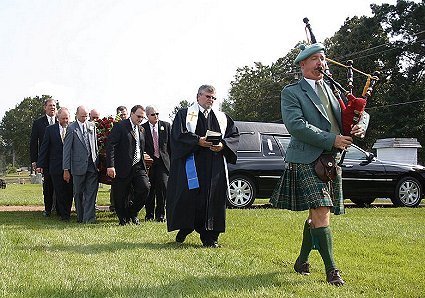


There is a commonality between these Irish funerals and ours throughout the lyrics of music. Though American music at funerals is somewhat depressing and solemn, they do provide hope for the future in seeing these loved ones again and explaining their importance during their lifetime. I hope to attend more funerals in America that obtain more lively music, and uplifting enviornments. If anything I would love my funeral to be celebrated with music just as the Irish use.


Redmond, JC, Adomaitis, MaryBeth
2007 Music at Irish Funerals.Love To Know Corp, November 1: 19,17.

Remembered with a Smile

As mentioned in previous posts, I mentioned how the topic of humor often came about during the Irish wake. This phenomenon as seen by many other cultures including Americans is one that is inappropriate when talking about death. Budda Oliver explains this phenomenon in his article "Attending a Funeral- The Irish Wake". He first explains how the wake is seen in Irish folklore as a period of time that the deceased person could wake up out of the state they are in. Being apart of folklore, this has obviously just been passed on the the generations and has not actually happened. However, he explains how folklores such as this one can be used to explain the phenomenon of a sense of humor during wakes. Oliver states "If you are preparing to attend an Irish wake, watch the temper and climate of the group you are with." (Budda 2010) What he means by this statement, is look around and take in the environment of the Irish wake. As many people are crying, you were more like to see laughter along with it. Oliver explains this phenomenon, "It is in this way that the person may be remembered with a smile, and their life retold for generations to come, a uniquely Irish way of passing into the afterlife." Because the Irish are humorous people normally, this type of reaction to death is very common.

For me, what stuck out the most within this quote was the words, the person may be remembered with a smile. From my childhood experiences, I had never found a smile on anyones face throughout the process of a wake nor funeral. If anything, someone forced a smile to keep their pride. However, you can detect a forced smile on anyone. As my father explained, friends and family of the deceased are never very far away from humor. Not only are they joking about the deceased one's lifetime, but they are genuinley happy to reminisce those who are no longer apart of our world. This reaction to death is much healthier and uplifting than the practice of mourning within many other cultures. Not that there is any right way to remember the death of a loved one, but why not remember the good rather than that bad?


Oliver, Buddda.
2010 Attending a Funeral - The Irish Wake. EzineArticles.com. .

Saturday, April 17, 2010

Supernatural Beliefs

When my father went to his grandmothers wake in Ireland, he stated that the customs of the wake were the most astounding. Unlike most wake services where the body is laid out in a casket for close family members and friends to look upon, the bodies are laid out on a bed within their house. According to Mary Murray Delaney author of "Funeral Customs- Irish Wake"," Wakes of times gone by began with neighbor women washing the body of the deceased and preparing it to be laid out on a bed or a table, often in the largest room of the house "(Delaney 1973: 5). The women who washed and laid out the deceased stay in the room until the body leaves for the funeral service or else the body will "attract evil spirits that would take the soul of the departed"(Delaney 1973:6). In earlier times, my father said that tobacco and pipes were place in the room where the deceased lay. Everyone who would have come into the room would take a puff of the pipe because the smoke was said to help avoid evil. Whereas, at american wakes, it is seen as disrespectful to have any type of smoking. It is seen as disruptive and unruly.

Along with alcohol, tobacco also symbolizes positive customs within social norms of the irish opposite of american customs. Not only did wakes take place in the home and involve drinking and tobacco use, but they lasted for almost two to three days until the funeral service was to take place. These two to three days involve singing, laughing, and telling stories of the deceased one. Having such good outlook on death is very rare. In most societies, death is to be dealt with as quickly as possible because societal fears of being around the deceased. Our wake are a total of about 6- 8 hours, and our funerals take about a half a day to complete. Opposing American traditions, the irish provide a true representation of love for the lost ones, and the want to spend as much time as possible in order to give a proper goobye to their loved ones.

Delaney, Mary Murray
1973 Of Irish Ways. Dillon Press Inc.