After looking into Irish funerary customs, I found a lot of differences about their outlook of death as compared to the American Outlook. In America, wakes are usually just within one afternoon, and are short lived. However, Irish wakes consist of three days full of upbeat music, games, and laughter. In Ireland, they celebrate the life of loved ones and spend the days after their death remembering them. However, it seems as if we Americans are afraid of reminisce the life of our loved ones how have passed, and just try to get over their death. Although Irish customs are seen as disrespectful or impolite within the America's societal norms, Ireland has been performing these customs for years. Within American culture, it is hard to understand the Irish unique traditions. However, we should to be opened minded in understanding the reasoning behind their ideas of death. I believe that in the end it would allow us to deal with death within much healthier circumstances.
Being Irish, I have learned a lot about my heritage through this blog, and realized that my family has a brighter outlook on death than I do. Learning about their use of music, and humor made me realize that there can be a positive outlook amongst death. Understanding their laments, and other funerary games provided their versions of mourning. But what was most astounding to me within all my research was the thought of celebrating ones death. Because the Irish focus on memories of their deceased loved ones rather than their actual death, they allow themselves to celebrate a lifetime and forget the bad times. This concept was most important to me because it helped to lessen my fear of death and all that has to come with it. My research allowed me to justify my opinions of death, and taught me to enjoy my life rather than to live being scared of dying. Therefore in the end, I hope that my loved ones will remember the good times rather than the bad and find ways to celebrate my life in laughter and memories rather than in sorrow and grief.
Friday, May 7, 2010

Thursday, May 6, 2010
Irish Association of Funeral Directors
According to the primary website of the Irish Association of Funeral Directors (IAFD), it is a " Customer Care Charter for the clients of (IAFD) Funeral Directors, guaranteeing minimum standards of professional competence, openness and caring for families at what tends to be a vulnerable time for many." This association provides help for families at one of their most vulnerable times, along with the death of a loved one. Their official website offers a list of things you must first do when a person of your family dies, and a PDF version including an even more sophisticated list. Also, they have many comforting opportunities that come along with the Funeral Directors who will be assigned to a client's funeral service. The person will take care of legal and financial situations, and organize possible organ donations, funeral homes, purchasing a headstone and even charities. If you think about the amount of relief that these people must feel with amount of responsibility put on their shoulders in such a difficult situation.
This association defines Irish culture and their funerary traditions in many ways. The association offers counseling and support groups for these people, along with many other alternatives for families to heal. These alternatives include a "Healing Space" in which reflections are placed once a month in order for these families to read, and allow them to give thought through this difficult time. The way that the irish provide services for their funeral ceremonies, is just another example of the practice of alleviating pain, and providing positive outlooks for the families of the deceased ones.
As compared to America, there are many services that provide the same things. However, the american way of doing things is alot more about mourning, and letting the family stay in their depressive state, rather than helping them to stay positive or bright upon these kinds of ceremonies. The ways in which the irish practice these ceremonies provide valuable insight, and healing centers rather than mounring routines and states of depression as in the U.S. What I have learned form the Irish is that death is just another part of life, and it is more about remembering the deceased one rather than mourning them.
Irish Association of Funeral Directors
2009 Certificate In Funeral Practice:Irish Association of Funeral Directors. Electric Document,http://www.iafd.ie/codeofpractice.php
This association defines Irish culture and their funerary traditions in many ways. The association offers counseling and support groups for these people, along with many other alternatives for families to heal. These alternatives include a "Healing Space" in which reflections are placed once a month in order for these families to read, and allow them to give thought through this difficult time. The way that the irish provide services for their funeral ceremonies, is just another example of the practice of alleviating pain, and providing positive outlooks for the families of the deceased ones.
As compared to America, there are many services that provide the same things. However, the american way of doing things is alot more about mourning, and letting the family stay in their depressive state, rather than helping them to stay positive or bright upon these kinds of ceremonies. The ways in which the irish practice these ceremonies provide valuable insight, and healing centers rather than mounring routines and states of depression as in the U.S. What I have learned form the Irish is that death is just another part of life, and it is more about remembering the deceased one rather than mourning them.
Irish Association of Funeral Directors
2009 Certificate In Funeral Practice:Irish Association of Funeral Directors. Electric Document,http://www.iafd.ie/codeofpractice.php
Friday, April 23, 2010
Music At Funerals
When picking music for funerals, you have to take everything into consideration. The location, the environment, the cause of death, and many other things are all important in choosing the music for the ceremony of a loved ones death. At a wake I once attended, the music was so low that you could hear the family members crying in the opposite room. Therefore, the environment was very solemn and depressing. The funeral home explained to my mother next to me in line that they couldn't come to an agreement over the music so the funeral home just decided to play some music in the background to liven up the mood a tiny bit.
After doing research, I found that at Irish funerals and wakes specifically pick their music to convey the person and what they were remembered for. As in the wake scene you see in the move "P.S I Love You", you come to find out that the song playing in the background was one of the deceased ones favorite songs. Because this song reminded his family of him, they played it in his honor. JC Redmond asserts in his article "Music At Irish Funerals", that music and dance is seen during the wake and funeral ceremonies in a way to deal with grief (Redmond,2007). There for the music will usually be upbeat and lively and depending on the location at either the home or the funeral home, the music will vary. Redmond states that whatever music is chosen, it has to represent the live of the deceased one, and lyrics in which provide faith, and reassure their ability to see this person once again in the future (Redmond,2007). Another interesting musical tradition JC Redmond explained was the use of the bagpipe within Irish funerals. Bag Pipes were used "to tug at one's heartstrings when played at a funeral" (Redmond, 2007) Bag pipes are also seen within English, and Scottish funerals. There were many songs traditionally performed during funerals. Below is a link that shows a Bag Pipe version of Joyful, Joyful which is played in many Irish funerals today.
Joyful Joyful by Bag Pipest Danny O'Ryan
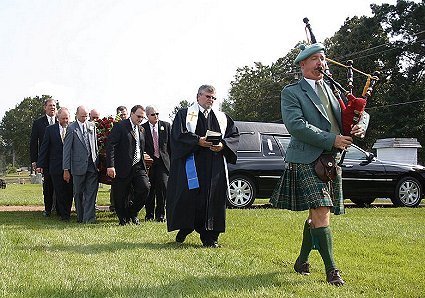
There is a commonality between these Irish funerals and ours throughout the lyrics of music. Though American music at funerals is somewhat depressing and solemn, they do provide hope for the future in seeing these loved ones again and explaining their importance during their lifetime. I hope to attend more funerals in America that obtain more lively music, and uplifting enviornments. If anything I would love my funeral to be celebrated with music just as the Irish use.
Redmond, JC, Adomaitis, MaryBeth
2007 Music at Irish Funerals.Love To Know Corp, November 1: 19,17.
After doing research, I found that at Irish funerals and wakes specifically pick their music to convey the person and what they were remembered for. As in the wake scene you see in the move "P.S I Love You", you come to find out that the song playing in the background was one of the deceased ones favorite songs. Because this song reminded his family of him, they played it in his honor. JC Redmond asserts in his article "Music At Irish Funerals", that music and dance is seen during the wake and funeral ceremonies in a way to deal with grief (Redmond,2007). There for the music will usually be upbeat and lively and depending on the location at either the home or the funeral home, the music will vary. Redmond states that whatever music is chosen, it has to represent the live of the deceased one, and lyrics in which provide faith, and reassure their ability to see this person once again in the future (Redmond,2007). Another interesting musical tradition JC Redmond explained was the use of the bagpipe within Irish funerals. Bag Pipes were used "to tug at one's heartstrings when played at a funeral" (Redmond, 2007) Bag pipes are also seen within English, and Scottish funerals. There were many songs traditionally performed during funerals. Below is a link that shows a Bag Pipe version of Joyful, Joyful which is played in many Irish funerals today.
Joyful Joyful by Bag Pipest Danny O'Ryan
There is a commonality between these Irish funerals and ours throughout the lyrics of music. Though American music at funerals is somewhat depressing and solemn, they do provide hope for the future in seeing these loved ones again and explaining their importance during their lifetime. I hope to attend more funerals in America that obtain more lively music, and uplifting enviornments. If anything I would love my funeral to be celebrated with music just as the Irish use.
Redmond, JC, Adomaitis, MaryBeth
2007 Music at Irish Funerals.Love To Know Corp, November 1: 19,17.
Remembered with a Smile
As mentioned in previous posts, I mentioned how the topic of humor often came about during the Irish wake. This phenomenon as seen by many other cultures including Americans is one that is inappropriate when talking about death. Budda Oliver explains this phenomenon in his article "Attending a Funeral- The Irish Wake". He first explains how the wake is seen in Irish folklore as a period of time that the deceased person could wake up out of the state they are in. Being apart of folklore, this has obviously just been passed on the the generations and has not actually happened. However, he explains how folklores such as this one can be used to explain the phenomenon of a sense of humor during wakes. Oliver states "If you are preparing to attend an Irish wake, watch the temper and climate of the group you are with." (Budda 2010) What he means by this statement, is look around and take in the environment of the Irish wake. As many people are crying, you were more like to see laughter along with it. Oliver explains this phenomenon, "It is in this way that the person may be remembered with a smile, and their life retold for generations to come, a uniquely Irish way of passing into the afterlife." Because the Irish are humorous people normally, this type of reaction to death is very common.
For me, what stuck out the most within this quote was the words, the person may be remembered with a smile. From my childhood experiences, I had never found a smile on anyones face throughout the process of a wake nor funeral. If anything, someone forced a smile to keep their pride. However, you can detect a forced smile on anyone. As my father explained, friends and family of the deceased are never very far away from humor. Not only are they joking about the deceased one's lifetime, but they are genuinley happy to reminisce those who are no longer apart of our world. This reaction to death is much healthier and uplifting than the practice of mourning within many other cultures. Not that there is any right way to remember the death of a loved one, but why not remember the good rather than that bad?
Oliver, Buddda.
2010 Attending a Funeral - The Irish Wake. EzineArticles.com..
For me, what stuck out the most within this quote was the words, the person may be remembered with a smile. From my childhood experiences, I had never found a smile on anyones face throughout the process of a wake nor funeral. If anything, someone forced a smile to keep their pride. However, you can detect a forced smile on anyone. As my father explained, friends and family of the deceased are never very far away from humor. Not only are they joking about the deceased one's lifetime, but they are genuinley happy to reminisce those who are no longer apart of our world. This reaction to death is much healthier and uplifting than the practice of mourning within many other cultures. Not that there is any right way to remember the death of a loved one, but why not remember the good rather than that bad?
Oliver, Buddda.
2010 Attending a Funeral - The Irish Wake. EzineArticles.com.
Saturday, April 17, 2010
Supernatural Beliefs
When my father went to his grandmothers wake in Ireland, he stated that the customs of the wake were the most astounding. Unlike most wake services where the body is laid out in a casket for close family members and friends to look upon, the bodies are laid out on a bed within their house. According to Mary Murray Delaney author of "Funeral Customs- Irish Wake"," Wakes of times gone by began with neighbor women washing the body of the deceased and preparing it to be laid out on a bed or a table, often in the largest room of the house "(Delaney 1973: 5). The women who washed and laid out the deceased stay in the room until the body leaves for the funeral service or else the body will "attract evil spirits that would take the soul of the departed"(Delaney 1973:6). In earlier times, my father said that tobacco and pipes were place in the room where the deceased lay. Everyone who would have come into the room would take a puff of the pipe because the smoke was said to help avoid evil. Whereas, at american wakes, it is seen as disrespectful to have any type of smoking. It is seen as disruptive and unruly.
Along with alcohol, tobacco also symbolizes positive customs within social norms of the irish opposite of american customs. Not only did wakes take place in the home and involve drinking and tobacco use, but they lasted for almost two to three days until the funeral service was to take place. These two to three days involve singing, laughing, and telling stories of the deceased one. Having such good outlook on death is very rare. In most societies, death is to be dealt with as quickly as possible because societal fears of being around the deceased. Our wake are a total of about 6- 8 hours, and our funerals take about a half a day to complete. Opposing American traditions, the irish provide a true representation of love for the lost ones, and the want to spend as much time as possible in order to give a proper goobye to their loved ones.
Delaney, Mary Murray
1973 Of Irish Ways. Dillon Press Inc.
Along with alcohol, tobacco also symbolizes positive customs within social norms of the irish opposite of american customs. Not only did wakes take place in the home and involve drinking and tobacco use, but they lasted for almost two to three days until the funeral service was to take place. These two to three days involve singing, laughing, and telling stories of the deceased one. Having such good outlook on death is very rare. In most societies, death is to be dealt with as quickly as possible because societal fears of being around the deceased. Our wake are a total of about 6- 8 hours, and our funerals take about a half a day to complete. Opposing American traditions, the irish provide a true representation of love for the lost ones, and the want to spend as much time as possible in order to give a proper goobye to their loved ones.
Delaney, Mary Murray
1973 Of Irish Ways. Dillon Press Inc.
Wednesday, March 31, 2010
Symbolism of Chaos
After interviewing my father, I became very interested in looking further into the customs of an Irish Wake. According to Roger Grainger author of the article "Let death be Death: Lessons, from the Irish Wake", Irish Wakes are a way of praising unruliness. By that statement, Grainger is trying to potray that instead of grieving death and being scared of it, people should learn to proclaim it.
In order to proclaim death the Irish sometimes even play out games in order to create chaos."The chaos through which the dead person must pass is reproduced in the chaotic reversals of social practice which occur during the mourning period, mirroring the contradictory emotions and impulses of bereaved individuals as they rebound between their need to suffer and be comforted, to remember and forget, in the urgency of their search for an escape from the anguish of the present" (Grainger 1998:132).
This way of dealing with death allows people to express their grief fears of death through irrational and energetic ways. This way Grainger states, allows people to "express discontinuity with the past and the affirmation of a new status and direction". From what information Grainger provides in his article, I have come to find that the Irish are very aware of an individual's presence in the universe also known being cosimcally inept. From the information provided in the article "Let Death be Death", it is very obvious that such celebrations, with"chaos" in the presence of the deceased at funerals is looked at as proclaiming one's ending of existence.
As put by Grainger, "The wake is society's way of saying that, to a greater or lesser extent, according to the size of the social group involved and the importance of the dead person's role within that group, the world has been radically and permanently changed" (Grainger 1998:132). By looking at death this way, It allows you to give closure to ones life and start onto the next step of your life with a clean and positive standpoint. It's not as if these people are simply forgetting about the past, but simply remembering their lives instead of their death.
Grainger, Roger
1998 Mortality:Let Death Be Death: Lessons From the Irish Wake. Morality 3(2):129-141.
In order to proclaim death the Irish sometimes even play out games in order to create chaos."The chaos through which the dead person must pass is reproduced in the chaotic reversals of social practice which occur during the mourning period, mirroring the contradictory emotions and impulses of bereaved individuals as they rebound between their need to suffer and be comforted, to remember and forget, in the urgency of their search for an escape from the anguish of the present" (Grainger 1998:132).
This way of dealing with death allows people to express their grief fears of death through irrational and energetic ways. This way Grainger states, allows people to "express discontinuity with the past and the affirmation of a new status and direction". From what information Grainger provides in his article, I have come to find that the Irish are very aware of an individual's presence in the universe also known being cosimcally inept. From the information provided in the article "Let Death be Death", it is very obvious that such celebrations, with"chaos" in the presence of the deceased at funerals is looked at as proclaiming one's ending of existence.
As put by Grainger, "The wake is society's way of saying that, to a greater or lesser extent, according to the size of the social group involved and the importance of the dead person's role within that group, the world has been radically and permanently changed" (Grainger 1998:132). By looking at death this way, It allows you to give closure to ones life and start onto the next step of your life with a clean and positive standpoint. It's not as if these people are simply forgetting about the past, but simply remembering their lives instead of their death.
Grainger, Roger
1998 Mortality:Let Death Be Death: Lessons From the Irish Wake. Morality 3(2):129-141.
Tuesday, March 30, 2010
Super Gram's Funeral
Having a Father whom is Irish is helpful in trying to understand the Irish funeral ceremonies. I decided to interview my father to explain an Irish funeral and it's unique traditions. I asked him six questions in which I believed would explain Irish funerals. First, I asked him to describe an Irish Wake. He answered, "An Irish wake is where the body is laid out in the house with the obligatory rosary beads the afternoon or evening before the funeral." He explained how Friends and relatives will gather around the casket and tell anecdotes about the deceased as a celebration of their life and are usually funny especially as more alcohol is consumed. He also added that there is food usually brought over by neighbors and friends and of course alcohol.
Secondly, I asked him to describe an Irish Funeral. He explained how in an Irish funeral the body is taken from the home to the funeral parlor for the closing of the casket and the to the church the night before the funeral. He added, “There is a service given by the priest and the deceased is usually eulogized again usually with a sense of humor. In the small villages there is a procession to the graveyard where the deceased is laid to rest."
The third question I asked was for him to tell one unique story that he experienced during an Irish funeral. He described his grandmas aka " super gram's" wake. He stated that "Usually the priest is an integral part of the community and knows everyone because of the Irish population's devout catholic beliefs." At his grandmother's funeral service the priest brought out super gram's handbag that seemed permanently attached to her. He began to pull items out of the bag and tell a little story about each item. He then explained how " Her rosary beads which she always carried with her and the head scarf she wore when her hair was in rollers and even a bottle of Guinness which she always had with her dinner each night."
Fourth, I asked him what the unique traditions that the Irish partake in during their funeral ceremonies and he told me how the unique traditions of an Irish funeral are the laying out of the body in the house and the drinking and amount of food. He then said "The Irish sense of humor is unique so the anecdotes about the deceased are usually funny so there is much merriment at an Irish funeral whereas for some other nationalities it is a somber and morose affair". I then asked, how do these families deal with the grieving process? He then explained how the families get through grieving with the support of the communities. He also said "In a lot of the villages in Ireland they are tight knit communities so the neighbors will provide food and drink for the deceased family and walk in the procession behind the casket. However the waking process helps the families as the Irish sense of humor celebrates the life of the deceased."
What i found most interesting about this interview was the topic of humor involved with these funeral ceremonies. As my father said, the irish have merriment in their funerals as compared to other nationalities whose funerals are "somber and morose." This is very true when comparing Irish and american funerals. It is enlightening to think about death in a more positive way because it's a way of celebrating ones life rather than grieving their loss. From this interview, I have become more engrossed in the topic of humor, and will go further into this topic in the near future.
David Cronin, interview by Samantha Cronin, Email, Norton,MA, 3/30/2010
Secondly, I asked him to describe an Irish Funeral. He explained how in an Irish funeral the body is taken from the home to the funeral parlor for the closing of the casket and the to the church the night before the funeral. He added, “There is a service given by the priest and the deceased is usually eulogized again usually with a sense of humor. In the small villages there is a procession to the graveyard where the deceased is laid to rest."
The third question I asked was for him to tell one unique story that he experienced during an Irish funeral. He described his grandmas aka " super gram's" wake. He stated that "Usually the priest is an integral part of the community and knows everyone because of the Irish population's devout catholic beliefs." At his grandmother's funeral service the priest brought out super gram's handbag that seemed permanently attached to her. He began to pull items out of the bag and tell a little story about each item. He then explained how " Her rosary beads which she always carried with her and the head scarf she wore when her hair was in rollers and even a bottle of Guinness which she always had with her dinner each night."
Fourth, I asked him what the unique traditions that the Irish partake in during their funeral ceremonies and he told me how the unique traditions of an Irish funeral are the laying out of the body in the house and the drinking and amount of food. He then said "The Irish sense of humor is unique so the anecdotes about the deceased are usually funny so there is much merriment at an Irish funeral whereas for some other nationalities it is a somber and morose affair". I then asked, how do these families deal with the grieving process? He then explained how the families get through grieving with the support of the communities. He also said "In a lot of the villages in Ireland they are tight knit communities so the neighbors will provide food and drink for the deceased family and walk in the procession behind the casket. However the waking process helps the families as the Irish sense of humor celebrates the life of the deceased."
What i found most interesting about this interview was the topic of humor involved with these funeral ceremonies. As my father said, the irish have merriment in their funerals as compared to other nationalities whose funerals are "somber and morose." This is very true when comparing Irish and american funerals. It is enlightening to think about death in a more positive way because it's a way of celebrating ones life rather than grieving their loss. From this interview, I have become more engrossed in the topic of humor, and will go further into this topic in the near future.
David Cronin, interview by Samantha Cronin, Email, Norton,MA, 3/30/2010
Saturday, March 27, 2010
The Funeral Lament

Picture Above titled "An Irish Lament for Alexander the Great"
In Ireland, one of the many unique customs practiced at funerals is the reciting of the Lament. Patricia Lysaght explains in her article, "Caoineadh os Cionn Coirp: The Lament for the Dead in Ireland" that "The lament for the dead has been the subject of comment by visitors to Ireland since the twelfth century". For those of you who don't understand what a Lament might be the definition by qtd (Honko,1974: 9) is "Laments are poetry of final parting" (qtd Lysaght, 1997:394).
The Irish recite these poems during the funeral ceremonies as a way of closure. As Lysaght explains, Laments are recited at the end of a funeral. It can be recited by a number of people, each reciting a single verse, or a single person. Laments are recited slowly, sometimes even in song form. Angela Burke says in her article, "The Irish traditional lament and the grieving process" that Irish Laments suggest a " high-pitched, inarticulate moaning, but the Irish word caoineadh, from which it derives signifies among other things, a highly articulate tradition of women's oral poetry".
From Bourke' article, I learned that these laments are usually on the women’s part. They are also meant to sometimes exemplify the grieving de-shoveled family members in the form of a song. Some examples of Laments translated from Gaelic to English still thrive today. (Bourke, 1988:287) These laments are interesting to me because they are very different from what our usual ceremonies entail musically.
At American funerals, our music is arranged by the family members and is played as background music during wakes. During funerals, there’s usually no music being played. A family member may be known to recite a poem about the person’s life but this usually happens during the wake process. I believe that this Irish singing tradition is beautiful and leaves a subtle positive note on the person’s life.
Lysaght, Patricia
1997 Folklore: Caoineadh Os Cionn Coirp. The Lament for the Dead in Ireland. 413(3):1-27
Bourke, Angela
1988 Women's Studies International Forum: The Irish traditional lament and the grieving process. 11 (4):287-291.
Friday, March 26, 2010
P.S I love you

In the movie P.S I love you starring Hilary Swank and Gerard Butler, an Irish funeral is held in a family restaurant and bar in NYC. The funeral scene is a prime example of certain traditions and rituals that are apart of ceremonies in Ireland. The gathering is rather large, of immediate family and loved ones. Although, people are grieving, the atmosphere is not dreary and rather upbeat. There is music on in the background which would have been the husband's favorite playlist. During the actual ceremony, people pass the box in which the man is cremated in and take a shot of whiskey upon it.
When I first watched this scene I thought it was bittersweet. I thought this because I was comparing it to the ordinary americanized wake where everyone stands in line and solemnly walks to the casket, makes a prayer, gives the family there condolences, and then leaves. However, at this particular wake, everyone stayed, conversed, and drank the night away in memory of the deceased. It was almost comforting to know that all these people loved him so much, and they celebrated his life in such a positive way. In Ireland, you would find this type of atmosphere at wakes of the deceased. According to Patricia Lysaght author of "Hospitality at wakes and funerals in Ireland from the seventeenth to the nineteenth century" , ""the Jesuit Christopher Holywood writing in 1617, tradesmen “in a certain city” were known to leave a large amount of money to be spent on drink at their wakes" (Patricia Lysaght,405). Lysaght explains how the catholic church tried to ban practices of alcoholic drink and feasting during funeral ceremonies but failed.
What Lysaght exemplifies in her article are the beginnings of the celebratory outlook on irish funerals, and how these traditions stuck over time. Since this movie was produced in 2007, it shows to say that these traditions have been of great importance within irish funeral ceremonies to this day. The fact is, unless you understand the Irish culture, how will you understand their rituals?
To see the funeral scene, click on the hyperlink below titled with the song played during the wake:
"Fairy Tale of New York"
Lysaght, Patricia
2003 Folklore: Hospitality at Wakes and Funerals in Ireland from the Seventeenth to The
Nineteenth century. Some Evidence From the Written Record. 114(3):403-426
Tuesday, March 23, 2010
The Notion of Celebrating Death
The general definition of funeral is a ceremony at which a dead person is buried or cremated.(wordnetweb.princeton.edu/perl/webwn) A funeral can have many different meanings depending on your cultural background. For me, I have always had a set idea of a funeral in which I inherited through american culture. This idea I have includes a service at which is solemn and heartbreaking. I have always been reluctant to be apart of such ceremonies, mainly because its hard to see the pained family members of the deceased, and the hardships of saying goodbye.
As a child, I would visit my family in ireland and found many differences within their culture. One of the biggest, being their celebration of the deceased. I first became aware of their notions of death when family was joking around about a funeral they attended the week before. I distinctively remember my super gram (great grandmother) telling a story of the men at the funeral who held a card game on the casket of one of their friends telling jokes and toasting to his death. This was hard for me to comprehend because of the experiences I had from the funerals back home. She went on to explain how the men then decided to leave a good hand of cards within their friends casket so that he would go to his grave a winner. I didn't understand how they could joke around about the death of a loved one, nor could I understand the fact of the drinking in the memory of a friend. This bothered me because it seemed as if they were actually celebrating this persons death. Ever since I have been interested in understanding such funeral traditions of the Irish.
I want to understand how the Irish deal with the deaths of loved ones, by examining their mourning processes, and wake and funeral traditions and values. I will do this by interviewing family members, and researching scholarly articles about these Irish funerary ceremonies and how they originated. Through my research, I hope to come to an understanding of these traditions and maybe even comply with this brighter outlook on death.
As a child, I would visit my family in ireland and found many differences within their culture. One of the biggest, being their celebration of the deceased. I first became aware of their notions of death when family was joking around about a funeral they attended the week before. I distinctively remember my super gram (great grandmother) telling a story of the men at the funeral who held a card game on the casket of one of their friends telling jokes and toasting to his death. This was hard for me to comprehend because of the experiences I had from the funerals back home. She went on to explain how the men then decided to leave a good hand of cards within their friends casket so that he would go to his grave a winner. I didn't understand how they could joke around about the death of a loved one, nor could I understand the fact of the drinking in the memory of a friend. This bothered me because it seemed as if they were actually celebrating this persons death. Ever since I have been interested in understanding such funeral traditions of the Irish.
I want to understand how the Irish deal with the deaths of loved ones, by examining their mourning processes, and wake and funeral traditions and values. I will do this by interviewing family members, and researching scholarly articles about these Irish funerary ceremonies and how they originated. Through my research, I hope to come to an understanding of these traditions and maybe even comply with this brighter outlook on death.
Subscribe to:
Posts (Atom)
